NOTE: I've updated this (06-2010) with the additional film types I've used!
Okay, sorry it took awhile to get this together. Busy and all that. Super long post here...for the few that will actually read the entire thing. So, previously I talked about
integral films, which are the kind that spit out of the front of a Polaroid camera and develop while you watch. The other, older kind of film is generally referred to as peel-apart, or sometimes pack film (though, technically, most Polaroid film comes in a pack). Peel-apart differs from integral in that it requires a couple steps to develop the print. It's called peel-apart because after you pull it from the camera, you wait some time for the print to develop and you peel off the top paper to see your print.
There are a couple different (somewhat affordable) formats of peel-apart: Type 80s and Type 100s. I won't be talking about large format peel-apart, as they require backs for professional cameras and I've never used any of them. The concept is the same, though.
I'll talk about the Type 100s first, as these are the more readily available types (for now). Plus, Fuji makes a Type 100 equivalent, so we can still use that when Polaroids are impossible to find.
Okay, now this is the part that confuses most people when they first start shooting peel-apart. Type 100 means nothing anymore. For some unknown reason, Polaroid renamed the entire 100 series films around 2000-2002. The new names are all in the 600s...and they have absolutely nothing to do with
600 integral film. They had started the 600 names in the 70s on a few of the films. And some of the same films were co-produced at the same time with two different names (107 and 667). Type 100s make sense because the first camera was the Polaroid 100. Not sure where the 600s came from.
Here is a list of the Type 100 films as they are currently labeled as 600s, the speed and color of the film, and the previous 100 name if applicable. And a few words on the film type. A lot of this is condensed from
The Land List. These packs all yield 10 shots. The older packs have eight, but they upped it to 10 sometime in the late '80s, early '90s.
Type 611 (low contrast ASA 3000 BW) - Never seen it, never used it.
Type 612 (high contrast ASA 20,000 BW) - 20,000? Can't even imagine how you could use this with a normal camera.
Type 691 (high contrast ASA 80 Color) -Seems to be the same as 669, except the speed is much slower than 80. I have to expose twice as long as 669. the box says "Special Program Film". No idea what it was made for.
Type 664 (ASA 100 BW) - The basic all-purpose 100 speed black-and-white format. This is what you would most probably use for your basic photo needs. This shot is actually a preview of my finally successful Polaroid/toy camera hybrid, which I will be posting about soon.
 Type 665
 (ASA 75 BW --- with a
negative. Previously know as 105) - This format actually has a negative along with a print. You have to rinse the negative to clean the black goop off. It is currently in high demand and typically quite expensive. Good for a larger format, highly detailed negative (with a decent camera).

 Type 667
 (ASA 3000 BW - previously Type 107/107C) - My favorite black-and-white format. It has a much higher contrast than the lower ASA films, though also less depth of field. You need a camera that can take 3000 film (more on that later). This is the film that makes good
goops.

 Type 668
 (ASA 75 Color - previously know as Type 108) - I've never used 668.
Type 669 - (ASA 75 Color - an improved version of 668/108) - Probably the most common color Polaroid film you will find. It has a slightly blue tint to it that becomes much stronger as it expires.

 Type 672
 (ASA 400 BW) - A higher speed black-and-white film.
Type 679 (ASA 100 Color) - On the box, it says it is a high-contrast film, while 669 is medium contrast. It is very yellow, and the developer look like mustard. Basically the same as 690.

 Type 689
 (ASA 100 Color) - Same as above, improved in some way. I find this has a slight purple cast to it. I've read that it is the same as Fuji FP-100C, but I think it is different.

 Type 690
 (ASA 125 Color) - This is the other 'common' color type. Color is a bit more accurate than 669. Less blue shift, more towards yellow.
Type 691 (ASA 80 Color) - For making slide transparencies. Makes a large positive "negative" in color! Sweet. This is obviously super expired.
Polacolor ID-UV (ASA 80 Color) - Similar to 669, except with a security coating that is visible under UV light. Some people say it is the exact same thing as 669, but I think it's different. Still a blue tint, but almost more grey-purple. The colors seem to be softer than 669. But maybe it's the same. I like this film and you can usually find it for less than 669.

 Fuji FP-100C
 - Fuji's answer to peel-apart color film. The colors are more 'true' than with Polaroid films, and a bit softer. I find that overexposing some adds a pleasing effect.

 Fuji FP-100C Silk
 - The same as above, except with a textured surface.
Fuji FP-100B - Probably equivalent to Type 664. I had a tough time with this at first until I learned how best to use it. Now I quite like it and plan on buying some more. It can usually be found for around $8 a pack online.

 Fuji FP-3000B
 - Equivalent to Type 667 3000 ASA film. It is a bit softer, and without the brown tones that you get with 667.
So those are the basic film types. Seems like there are a couple others, but you get the idea. When you know what to look for, it becomes kind of obvious what fits in this type. It is rectangle in shape and is 3.25 x 4.25 inches. So...what kinds of cameras do you need to shoot with Type 100s? You CAN NOT use a
600 film camera. Nor can you use an SX-70. You need a peel-apart camera. There is no way I can cover all the different cameras that will work with this film type. That should tell you that you have TONS of options. I will just cover the basics and what NOT to buy. Like I said, none of the cameras previously mentioned in the integral film post will work. There are two basic styles of camera for Type 100: the folding camera and the hardcase. I only have one folding camera, my 195, though I have a 102 coming in the mail that I got for dirt cheap on Ebay just because.
There are three basic styles of folding camera for Type 100s. The original design, which only changed in detail but not basic design. Starts with the Polaroid 100, and keeps going up in numbers for awhile. They all basically look like this (obviously borrowed from
Land List):
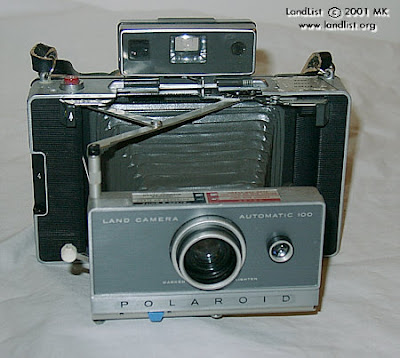
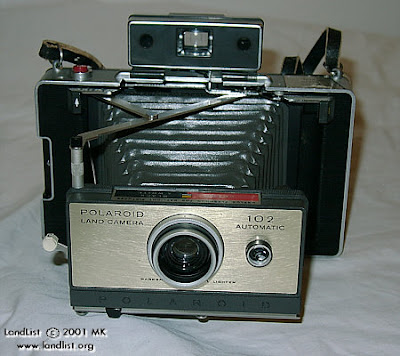
I'm told the 100 is the best to buy from this series, as subsequent versions are dumbed down, with fewer options. The 100 has more film speed options. Now, the thing about these cameras is that they use an outdated battery format. I guess you can still get them if you really try, but most people do a
conversion to make AA batteries work. I'll be trying this out when I get my 102.
The next folding type is similar to the above, except the quality is much higher. This includes the 180, 185, 190 and 195. I have a 195. You see how much larger the lens is. I paid about $200 for mine, but now I see them going for around $400 on Ebay.
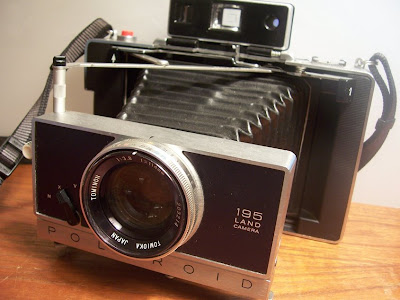
The nice thing about these cameras is that they are battery free....entirely manual. So there is no automatic exposure adjustment, allowing you full control over your exposure. This is sometimes nice, while other times it means a couple messed up Polaroids while you tweak your settings. I have a Polaroid light meter, but it's absolutely useless as it's always sunny here, so the dial is always all the way to one end. I just guess pretty good. Another advantage to these is the quality of the lens, allowing for very sharp shots. Works particularly well with the 665 negative.
The third type of folder includes the ProPack, The Reporter, and the same basic camera with a few other names. I had a Propack, but it didn't work so I ripped it apart to use the back. They looks like this (again, from Land List):

The other basic type of peel-apart camera is the hardcase. These do not fold, and do not have bellows. I personally prefer these, just because. Though they are tougher to lug around, particularly while hiking and such. They aren't heavy, but they take up a lot of space. These cameras all use 2 AA batteries. When you buy one, though, the old batteries may still be in the camera and lots of corrosion present. I've always been able to clean them up with WD-40. I have a Super Shooter and a Colorpack III that I use. I've had others, but they are all pulled apart. You can get these for cheap. I mean...cheap. Try not to spend more than $5. Seriously.

They all look pretty much exactly the same, except with different names, sometimes different colors, and different faceplates. Some are better than others. Some have plastic lenses while some are glass. Some seem to have more depth of field than others. Some have timers on the side, some have focusing aids. Just depends on what you find. In my opinion, the Colorpack series is the best (the the Super Shooters are pretty similar), particularly II and III, particularly for one reason that I'll guess I'll mention right now: film speed switch.
Remember above how there are different film speeds, from 75 to 3000? Well, if you use 3000 film in a camera that is set for 75 ASA, you will just get a white Polaroid shot. Looking at the picture of the Super Shooter above, you can see a switch on the top front. Well, this lets you change the camera speed to use both 75 (and 100) ASA as well as 3000 (Type 667). Always look for that switch on the hardcases, or they will only be able to shoot 75/100 ASA.
There is a 3000 speed camera, though, and you won't be able to use 75/100 ASA film in it. It is aptly named Big Swinger 3000. The 3000 should give it away.

It is fixed focus, as 3000 speed is, well, a fixed focus film, I guess. It's a very groovy-looking camera, but one camera that does both speeds is best.
There is one other very fancy Polaroid camera called the
600SE. It is large and actually takes "backs", meaning it has different attachable backs for different formats, including actual 120 film, I guess. I don't own own. My 195 is good enough for me. The 195 is nice in that it also takes the other peel-apart film format: Type 80.
Type 80s are square format. Polaroid stopped producing these a couple years ago, so they are tough to find nowadays. Ebay is the best bet, and Unsaleable makes a square format called
Chocolate, which is quite expensive. Film varieties for Type 80s include:
Type 84 (100 ASA BW)
Type 85 (ASA 80 BW with a print and negative)

 Type 87
 (ASA 3000 BW) - Has a nice goop side like 667.

 Type 88
 (ASA 75 Color)

 Type 89
 (ASA 125 Color)
Viva (ASA 80 Color)
Chocolate


This format is 90 percent dead. I have 10 packs of square film left, which I'm saving for some special occasion, I guess.
There aren't many square format Polaroid cameras to choose from. They are all hardcases. The most obvious is the aptly names "Square Shooter". The other is the "Zip" and "Electric Zip". I use a Square Shooter II, but I replaced the front so I could use the 75/3000 switch. The Square Shooter body is smaller than the Type 100 cameras, as the Type 80 is smaller.

Now it can get a bit confusing sometimes. A Square Shooter and a Zip will only take Type 80. Easy enough. There are some cameras that take both 100 and 80 films. I wouldn't worry about this too much, as all of them take Type 100, aside from the two square-only cameras. The Super Shooter takes both. The Colorpack only takes 100. You won't be shooting much Type 80 at this point, so buy whatever, and if you want to shoot Type 80, buy a Square Shooter II or III. Aaaand... Just to throw you off, though, the Square Shooter and Zip cameras only take ASA 75/100 films! So if you want to use Type 87 (ASA 3000), you either have to use a Super Shooter or a new-style folder, such as the Propack or Reporter. Or!!! You can do as I did and take the front from another camera and put it on your Square Shooter. Type 80 seems to be the odd man out, but it's really my favorite format and I'm super bummed it's gone. It's worth digging some up from Ebay and trying it out.
Just a note about older and newer black-and-white films. There are two types, coater and coaterless. Type 107, 105, 665 and 85 come with a tube of goopy fixer that you spread over your print after developing. If you don't do this, the photo will turn brown. Coaterless doesn't require this (though some people use it anyway). 665 and 85 (types with the negative) are the only current films that require coating.
There is another peel-apart type...rollfilm. Really difficult to find, not really a good starting point for a newbie Polaroid user. Check out my post on
Type 40 rollfilm. There is also Type 20 and 30 rollfilm, which I know very little about.
There are ALSO large format peel-aparts. I've never used any of them. They are very expensive, and the cameras are all pro cameras that use Polaroid Type 50 backs. You will have to go elsewhere for info on these, as I know very little about the cameras. The concept is the same, though, just bigger. And even
bigger and
bigger. I'd like to use the Type 50s someday, but it's probably not going to happen anytime soon. Fuji makes a larger peel-apart also.
So, after all that, how do you use a peel-apart camera? Integral just spits the film out. Peel-apart has a process. I've reached my limit here, so I will let these Super Shooter and Colorpack II instruction booklets explain everything...


Loading is the same for all pack film cameras, folding and hardcase.


As is developing...The "yellow tab" isn't actually yellow anymore.


And most cameras actually have rollers rather than spreaders (flat bars) that need to be cleaned. Same concept. You wil have to do this occasionally, or you will end up with poor developer spread from all the gunk on the rollers/spreader bars. Sometimes cool, sometimes ruining the shot.

Seriously, check out the
Land List page on 80/100 pack film cameras. It has that nice 'tree' so you can see all the different styles of camera and descriptions of every single one of them. I found it all very confusing at first, but when you understand the basic camera types, it makes complete sense. It's a very useful resource when you see a camera on Ebay or wherever, but you aren't sure if it takes whatever film, or whether it's a crappier or more feature-laden version.
So, bring on the dancing horses and shoot, shoot, shoot, my friends.


